
PANORAMA Models Overview 🔭#
PANORAMA detects macromolecular systems in pangenomes using user-defined models. These models are an exhaustive and specific representation of a system. They describe the presence/absence rules of protein families constituting a system, how they are organized in genomes, and what genomic constraints govern their presence.
System models are written in JSON and provide a flexible, hierarchical structure that captures both essential and optional elements of complex systems.
Definition and Purpose 🧭#
A system model in PANORAMA serves two main purposes:
Represent the system in a unique way
Models specify which protein families are required, optional, or excluded for a given system.Guide the detection process
The model governs how PANORAMA searches for gene co-occurrence and proximity in the pangenome context graph.
Models allow users to capture:
Core and variable components of a system,
Modular architecture (via Functional Units),
Flexible quorum rules,
Genome organization constraints (e.g., clustering, strand consistency),
Inhibitory or exchangeable elements.
Structure (Brief)#
Each model file is a single JSON object composed of:
name: The system’s identifier.parameters: Detection parameters at the model level (e.g., quorum, transitivity).func_units: A list of Functional Units (modules), each of which groups multiple protein families.
The structure is hierarchical:
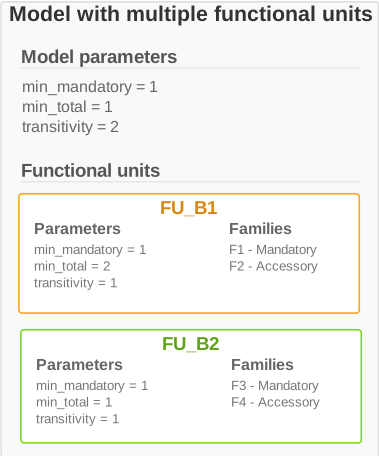
Each Functional Unit and Family has a presence type (mandatory, accessory, neutral, forbidden) that
governs how it contributes to system detection.
Detection rules are defined at both the model level and the functional unit level, using parameters such as:
min_mandatorymin_totaltransitivitysame_strand
For full details, see:
PANORAMA models gallery 🎨#
All existing PANORAMA models are available on the PANORAMA models repository.
Most of them are directly translated from different sources, such as PADLOC or MacSyFinder.
We welcome contributions and would like to provide PANORAMA users with a variety of models for a multitude of analyses. You can contribute to the creation of new models by following the guide here.
Translate models#
PANORAMA can translate several sources (see PANORAMA models repository).
We are trying to keep our models updated. But in case we miss it,
you can translate the model yourself with panorama utils --translate command.
Look here for more information: PANORAMA – Model Translation Guide